What Size Mini Split for a 2 Car Garage?
Choose a mini split for a 2 car garage by its calculated heating and cooling load, then compare installation needs. The 18,000 and 24,000 BTU systems below are candidates, but insulation, ceiling height, climate and door use determine which capacity fits.
On this page (8 sections)
- What size mini split works for a 2 car garage?
- Which garage details change the size you need?
- Which 18,000 to 24,000 BTU options can you compare?
- Should you choose 18,000 or 24,000 BTU?
- What should you check before installing a garage mini split?
- How should you use and care for a garage mini split?
- Which mistakes should you avoid before buying?
- How do you choose the right mini split for a 2 car garage?
Choose a mini split for a 2 car garage by its calculated heating and cooling load, then decide which installation method fits your project. The 18,000 and 24,000 BTU systems below are candidates, not automatic matches for every garage.
An insulated garage used as a daily workshop needs a different plan from a drafty parking space opened several times each morning. Your ceiling height, climate and preferred indoor temperature also matter.
For a wider overview of capacity and setup, see our mini split sizing and installation guide.
What size mini split works for a 2 car garage?
An 18,000 or 24,000 BTU system can suit some two-car garages, but a load calculation should decide the capacity. A smaller or larger system may be needed outside those conditions.
Measure the inside length and width to find floor area, then record the ceiling height. Include any open storage area or workshop that you expect the same indoor head to condition.
| Garage condition | What it changes | Buying action |
|---|---|---|
| Insulated walls, ceiling and overhead door | Slows heat gain and heat loss | Size for the improved building, not its old condition |
| Uninsulated roof or strong afternoon sun | Adds summer cooling demand | Include roof construction and sun exposure in the calculation |
| Tall ceiling or open loft | Changes the space and airflow needs | Give the installer heights and a simple floor plan |
| Frequent overhead-door opening | Lets conditioned air escape | Set realistic expectations for recovery between openings |
| Attached garage | Changes heat transfer through shared surfaces | Identify which walls and ceilings border conditioned rooms |
| Heat-producing workshop equipment | Adds cooling demand during use | Describe the equipment and its operating schedule |
A coverage figure is useful for narrowing a search, but it isn't a sizing formula. For example, a shaded, insulated space and a sun-baked garage with an exposed roof can share the same footprint and have different loads.
Our guide to choosing a mini split size explains what to gather before requesting a calculation.
Which garage details change the size you need?
Insulation, air leaks, weather and work habits matter more than the number of parking spaces. Decide how you will use the garage before choosing equipment.
How do insulation and garage doors affect mini split size?
Insulation reduces heat flow through the building, while air sealing limits drafts. Check both, because insulated walls won't stop outdoor air from entering through gaps around the overhead door.
Inspect the bottom seal, side seals and entry-door weatherstripping. Fix large gaps before the final sizing assessment so the equipment matches the garage you intend to use.
Don't block required ventilation openings while sealing the space. Keep any separation between an attached garage and the home intact when planning holes or routing services.
Does ceiling height matter when sizing a mini split for a 2 car garage?
Yes, ceiling height affects the load and air distribution. A tall garage also gives warm air more room to collect above the occupied work area.
Tell the installer where you stand or sit while working, not just where the ceiling ends. The indoor head needs an open path toward that area rather than toward the tops of storage racks.
How does your garage use change the load?
Daily workshop use calls for more steady comfort than brief trips to a parked car. People, lights and running equipment can add heat, while opening the overhead door replaces indoor air with outdoor air.
State your actual goal: comfortable woodworking sessions, cooler exercise space or moderate winter warmth. A larger unit won't hold an indoor temperature while a wide garage door stays open.
If insulation upgrades are planned soon, discuss them before buying. Sizing for the current drafty shell can leave you with excess capacity after the improvements.
Which 18,000 to 24,000 BTU options can you compare?
These four heat pumps split into conventional installation and DIY Quick Connect options. Start with the capacity your garage needs, then compare controls, efficiency and installation work within that size.
Pioneer Diamante Pro 18000 BTU 230V
The Pioneer suits a garage whose load fits its capacity and whose owner wants adjustable airflow and washable filtration. Pioneer recommends it for 500 to 750 sq ft and specifies 21.0 SEER2 cooling efficiency.
Its motorized up-down and left-right louvers help direct air across an open garage. I FEEL sensing uses the temperature near the remote, which can help when your workbench sits away from the indoor head.
Keep that remote out of direct sun and away from heat-producing tools for a useful reading. The washable filter and self-clean cycle support routine care, though the cycle doesn't replace filter cleaning.
Pioneer specifies heating operation down to -4°F. Ask for heating output at your local winter design temperature before relying on it as the garage's only heat source.
Choose it for airflow control and cooling efficiency. Skip it if you need a Quick Connect DIY system, and allow for the separately sold AirLink module if phone control matters.
For other options in these capacity bands, see our 18,000 and 24,000 BTU mini split guide.
Cooper & Hunter 24000 BTU 230V
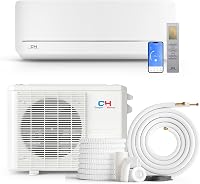
The Cooper & Hunter MIA suits a higher-load garage where you plan to hire an installer and want app control included. Its Smart Kit lets you adjust temperature remotely and set schedules.
Cooling efficiency is 18.7 SEER2, and Cooper & Hunter specifies heating operation down to 5°F. For colder conditions, confirm available heating output and the need for another heat source before ordering.
The installation kit includes a 16 ft insulated copper line set, communication cable and drainage extension. Have the installer measure the route first, since bends and vertical travel count toward the distance.
Choose it for a professionally installed garage system with included smart controls. Skip it if you want to make the refrigerant connections yourself or if your garage needs less capacity.
Delivery also needs planning: it ships by freight to the nearest accessible point outside your home. Cooper & Hunter requires professional installation and registration within 60 days of installation, so arrange both steps in advance.
MRCOOL DIY Select 18000 BTU 230V
This MRCOOL suits a properly sized garage project where the owner wants to make the system's Quick Connect refrigerant connections. MRCOOL recommends it for rooms up to 800 sq ft.
The pre-charged line set avoids the need for a vacuum pump, gauges, brazing or refrigerant handling during that connection process. You still need a sound mounting plan, a suitable line route and compliant electrical work.
It offers up to 17.3 SEER2 cooling efficiency and up to 8.5 HSPF2 heating efficiency. Controls include the MRCOOL Comfort App and voice assistants, useful for setting the garage temperature before a work session.
Choose it when both the capacity and DIY approach fit. Skip it if you can't safely mount the equipment, follow the connection instructions or arrange the required electrical work.
Don't let the coverage recommendation decide the purchase by itself. Read how DIY mini split systems work to understand the work beyond connecting the lines.
MRCOOL DIY Select 24000 BTU 230V
The larger DIY Select suits a garage with a confirmed higher load whose owner wants the same Quick Connect approach. MRCOOL recommends it for rooms up to 1,050 sq ft.
It offers up to 16.5 SEER2 cooling efficiency and up to 8.3 HSPF2 heating efficiency. The MRCOOL Comfort App and voice controls are included among its control options.
Choose it when the load calls for the larger capacity and you can manage the installation tasks. Skip it as an upgrade bought only for faster cooldown in a smaller garage.
Its larger coverage recommendation doesn't promise that air will reach behind partitions or through an enclosed storage room. Plan the airflow path as carefully as the capacity.
Before choosing either MRCOOL for winter heating, confirm its heating output and operating limits for your climate. The efficiency figures alone don't answer that question.
Should you choose 18,000 or 24,000 BTU?
Choose the capacity that covers the calculated load without needless excess. Ask how low the system can reduce its output as well as how much it can deliver at peak demand.
An inverter compressor adjusts output, but it still has a minimum operating level. If that level exceeds the garage's needs during mild weather, the system may cycle instead of running steadily.
Oversizing can also reduce moisture removal when cooling cycles become too short. Undersizing creates the opposite problem: the equipment may run continuously without reaching your chosen temperature during peak weather.
Avoid buying extra capacity solely to recover from an open garage door. Closing the door and reducing leaks address that problem more directly.
Compare seasonal efficiency within the capacity you actually need. SEER2 describes cooling efficiency, while HSPF2 describes heating efficiency; neither predicts your exact bill or confirms cold-weather heating output.
If you are deciding between these capacity bands, our 18,000 and 24,000 BTU comparison guide covers more options. Have the installer explain any large difference between the heating and cooling loads before selecting one system for both.
What should you check before installing a garage mini split?
Confirm electrical service, mounting, line routing and drainage before ordering. All four systems here use 230V power, so have a qualified professional verify the required circuit and available panel capacity.
Where should the indoor head go?
Place the head where air can travel across the occupied area without hitting tall shelves or a parked vehicle immediately. Follow the required ceiling and side clearances, and leave room to open the unit for care.
Check the overhead door in its fully open position. Door tracks, open panels and stored items must not block airflow or service access.
One indoor head works best in an open zone. A closed workshop or room behind a partition may need a separate plan rather than a larger head in the main garage.
How should you plan the outdoor unit and line route?
Choose a stable outdoor location with the required airflow and service clearances. Keep it clear of vehicle paths, stored materials and roof runoff, and account for snow where relevant.
Measure the full line route, including rises and bends. Follow the manual for allowed lengths, elevation changes and handling of excess line rather than forcing it into a tight coil.
A factory-charged condenser doesn't make every system suitable for DIY work. The connection method determines the refrigerant work required; our guide to pre-charged DIY mini splits explains that distinction.
Where will the water drain?
Plan a clear drainage route from the indoor unit before choosing its wall position. Gravity drainage needs a continuous fall, and discharge should not create puddles beside the garage or across a walkway.
If the route can't drain by gravity, assess a suitable pump. Our mini split condensate pump guide explains when that extra part may be needed.
The outdoor unit can also release water during heating defrost cycles. Account for that water so it doesn't create an icy walking surface in winter.
A mini split does not provide fresh-air ventilation or make an enclosed garage safe for a running engine. Keep vehicle exhaust and workshop dust control separate from the comfort system.
For more garage-specific equipment choices, see our best mini splits for garages.
How should you use and care for a garage mini split?
Keep airflow clear, clean filters regularly and use a steady, realistic temperature setting. Garage dust can build up quickly, especially near woodworking, sanding or other dirty work.
Inspect filters more often during dusty projects and clean them according to the manual. For a washable filter, let it dry fully before reinstalling it.
Use dust collection at the tool rather than expecting the mini split filter to handle workshop debris. Keep paint mist, grinding dust and other airborne contaminants away from the indoor head.
Start conditioning before a planned work session instead of demanding an instant temperature change. Lowering the cooling setpoint far below your goal won't increase the unit's maximum capacity.
During humid weather, avoid switching the system off and repeatedly opening the overhead door between short visits. Choose operating times that match your use and keep the door closed while cooling.
Keep leaves and debris away from the outdoor unit, and check that drainage remains clear. Follow the manual's service schedule and arrange attention for persistent leaks, unusual noise or reduced airflow.
Which mistakes should you avoid before buying?
Avoid sizing by parking spaces, assuming every kit is DIY and treating minimum heating temperature as full heating capacity. These errors can leave you with the wrong equipment even when the advertised coverage seems suitable.
- Buying before insulation work: Finish planned improvements or include them in the load calculation.
- Ignoring workshop heat: Tell the installer about equipment that runs during the hottest part of the day.
- Choosing by quiet-mode figures alone: The sound level at higher output matters when the garage needs substantial heating or cooling.
- Forgetting service access: Leave room to reach filters, connections and outdoor components after shelves and vehicles are in place.
- Assuming one head serves closed rooms: Air needs an open route to the areas you want conditioned.
- Relying on app controls to fix sizing: Remote schedules help with timing, but they can't correct insufficient output or blocked airflow.
Ask for an installation plan that names the equipment, electrical work, drainage route and required accessories. That makes it easier to compare the full scope of conventional installation with a DIY project.
How do you choose the right mini split for a 2 car garage?
Choose your mini split for a 2 car garage in this order: confirm the load, check winter heating output, then settle on the installation method. If neither capacity fits, expand the search instead of forcing a choice among these four.
Pick the Pioneer when the smaller capacity fits and airflow control matters. Choose Cooper & Hunter when the garage needs the larger capacity and you want professional installation with included app controls.
Choose the MRCOOL DIY Select in the capacity your calculation supports when you want Quick Connect refrigerant connections and can handle the remaining project work. Arrange electrical help and permits as required before the equipment arrives.
If your garage includes a large open workshop or adjoining space, use our mini splits for 1,000 sq ft guide to widen the comparison after confirming the load.
Frequently asked questions
What size mini split do I need for a 2 car garage?
Choose the capacity that matches your garage's calculated heating and cooling load. The 18,000 and 24,000 BTU systems in this guide are options to compare, but insulation, ceiling height, air leaks, climate and garage-door use can make either size unsuitable for a particular space.
Is an 18,000 BTU mini split enough for a 2 car garage?
An 18,000 BTU mini split can suit a two-car garage when its heating and cooling output matches the load. Insulated walls, a sealed overhead door and limited door opening help reduce demand, but a professional should check the actual building conditions before you commit to that capacity.
Should I get a 24,000 BTU mini split for my garage?
Choose 24,000 BTU only when the calculated load calls for it. Extra capacity is not a substitute for sealing major gaps or insulating the ceiling, and an oversized unit can cycle too often when demand is low; ask about both peak output and minimum output before buying.
Can one mini split heat and cool a two-car garage?
One single-zone heat pump can heat and cool an open two-car garage when its capacity and airflow suit the space. Tall storage racks, partitions or an enclosed workshop can limit air movement, so plan the indoor head location and assess separate rooms before choosing a single head.
Can I install a mini split in my garage myself?
Some systems allow DIY refrigerant connections through pre-charged Quick Connect lines, but electrical work, mounting and drainage still need proper planning. Local rules may require permits or licensed work; read our guide to installing a mini split yourself before choosing a system or planning the job.