What Size Mini Split Do You Need?
The answer to 'what size mini split do I need?' starts with your room's heating and cooling loads. Use floor area to narrow the search, then have an HVAC professional match the equipment's capacity range to your room and climate.
On this page (10 sections)
- What size mini split do I need for my room?
- How do you estimate the room's heating and cooling load?
- Why can two rooms of the same size need different units?
- How should you size for cold-weather heating?
- What can go wrong if the mini split is oversized or undersized?
- Which mini split capacities are worth comparing?
- How many indoor heads do you need?
- What should you confirm before choosing a capacity?
- How do you keep a correctly sized mini split working well?
- What size mini split should you choose?
The mini split size you need comes from your room's heating and cooling loads, not floor area alone. To answer “what size mini split do I need?”, measure the space, account for its insulation and windows, then match equipment to a room-by-room load calculation.
Start with the area one indoor head will actually serve. A living room connected to an open kitchen is different from the same floor area divided into closed bedrooms.
If you're comparing common capacities, see our 9,000 and 12,000 BTU mini split guide and our 18,000 and 24,000 BTU mini split guide.
What size mini split do I need for my room?
Choose the capacity that meets the calculated load, with enough adjustment for milder days. A room label such as “small bedroom” or a coverage claim on a box can't settle the choice.
BTU per hour describes heating or cooling capacity. For reference, 12,000 BTU per hour equals 1 ton of capacity; it doesn't describe the equipment's weight or electricity use.
| Capacity class | Sensible reason to compare it | What to avoid |
|---|---|---|
| 9,000 BTU | A small zone with a low calculated load | Assuming every small bedroom needs this much |
| 12,000 BTU | A defined room whose load fits this class | Treating a coverage estimate as a guarantee |
| 18,000 BTU | A larger zone with a higher load | Moving up just for faster cooldown |
| 24,000 BTU | An open area with a substantial load | Using one large head to serve closed rooms |
These are capacity classes, not a square-foot sizing chart. A shaded, insulated room may need less equipment than a sunny room of the same size with a vaulted ceiling.
If the calculation falls between common sizes, ask the installer to compare actual operating ranges. The next larger model isn't automatically the better choice.
How do you estimate the room's heating and cooling load?
A load calculation estimates how much heat the equipment must remove or replace under local design conditions. For a home, ask for a room-by-room Manual J calculation rather than a recommendation based only on floor area.
Measure length times width for each rectangular part of the space, then add those areas together. Record ceiling height separately, including sloped or vaulted sections.
Gather these details before requesting a quote:
- Window dimensions, direction and shading
- Insulation in the walls, ceiling and floor
- Drafts around doors, windows and other openings
- Whether the floor sits above conditioned or unheated space
- Usual occupancy and heat-producing equipment
- Connections to hallways, stairs and adjoining rooms
- Desired indoor temperatures and hours of use
Tell the contractor about planned upgrades, too. Adding attic insulation or sealing major leaks before installation may change the capacity you need.
Ask to see separate heating and cooling load results. Also ask which weather conditions and building details the contractor used, especially if two quotes recommend different sizes.
For a garage or workshop, include vehicle doors and how often they open. Our mini split guide for a 2-car garage covers the extra questions that come with that space.
What size mini split do I need if the room has high ceilings?
High ceilings require more detail in the load calculation, not a fixed increase to the next equipment size. Extra wall area, roof exposure and air movement all matter.
A ceiling fan may help mix room air, but it doesn't replace heating or cooling capacity. Have the installer consider head location and airflow so conditioned air reaches the occupied part of the room.
Avoid adding separate guesses for ceilings, windows and sunshine to a rough square-foot estimate. That approach can count the same heat gain more than once and lead to oversized equipment.
Why can two rooms of the same size need different units?
Two rooms need different capacities when their heat gain and heat loss differ. Exposure, insulation and air leakage can matter as much as area.
A 400 sq ft room with large west-facing windows receives a different afternoon heat load from a shaded room with modest windows. Exterior shading can reduce that gain before the air conditioner has to remove it.
A room over an unheated garage may lose heat through its floor. An interior room surrounded by conditioned spaces has a different heating demand.
Use patterns matter as well. A workshop filled with operating equipment needs a different assessment from a spare room used occasionally, even if both have the same dimensions.
Tell the installer if you plan to let the space get very hot or cold between uses. Recovery time matters, but buying excess capacity for occasional rapid recovery can hurt comfort during normal operation.
How should you size for cold-weather heating?
Select equipment using heating output at your local winter design temperature. A minimum operating temperature tells you when a unit can run, not whether it can supply all the heat your room needs.
Ask for a capacity table showing output at the temperatures relevant to your home. Compare that output with the heating load rather than assuming the model's headline capacity stays unchanged as weather gets colder.
Discuss defrost operation and a backup heating plan if the mini split will be the room's main heat source. The installer should explain how the space will stay comfortable during severe weather.
Don't solve a heating shortfall by choosing a much larger unit without checking summer performance. A heating-focused choice still needs low enough cooling output for mild, humid days.
Our guide to how mini splits work in cold weather explains why performance varies by model and temperature.
What can go wrong if the mini split is oversized or undersized?
An undersized system may miss the set temperature during peak weather, while an oversized one may struggle at low demand. Both problems start with a mismatch between room load and equipment output.
A correctly sized inverter mini split can run for long periods at reduced output. Long runtime alone doesn't mean it is too small.
Look instead at whether it maintains the chosen temperature under expected conditions. Dirty filters, blocked airflow or installation faults can also cause weak performance, so don't assume capacity is always the cause.
With an oversized system, the room may need less cooling than the compressor can deliver at its lowest output. Frequent cycling can make temperature control less even and reduce moisture removal.
Ask about minimum and maximum capacity, not just nominal BTU. This is especially useful for a tight, shaded bedroom where demand may stay low for much of the season.
Which mini split capacities are worth comparing?
Compare these systems after you know your load range, available power and installation plan. Their different capacities and connection methods solve different needs; none is a universal room-size answer.
Pioneer Diamante Pro for a smaller defined zone
The Pioneer Diamante Pro 12000 BTU 230V suits a bedroom, office or addition whose load fits this capacity class. Pioneer recommends it for 350 to 500 sq ft, but the room calculation takes priority over that range.
Its motorized up-down and left-right louvers offer airflow adjustment for an open room. I FEEL sensing measures temperature near the remote, so keep the controller near the occupied area and away from direct sun.
Cooling efficiency is 20.0 SEER2, and heating efficiency is 9.5 HSPF2. Pioneer specifies heating operation down to -4°F, which still calls for a check of available output at your winter design temperature.
Choose it if you want remote-based control and reusable filters in a correctly sized single zone. Skip it if you require included phone control, since the optional AirLink module is sold separately, or if your electrical plan doesn't support 230V.
Cooper & Hunter for a larger open area
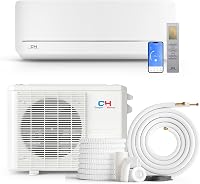
The Cooper & Hunter 24000 BTU 230V fits a large open room, workshop or office when the calculated load calls for this capacity. It requires professional installation, so arrange the installer before ordering.
An included Smart Kit supports app control and scheduling. The installation package includes a 16 ft insulated copper line set, communication cable and drainage extension; have the installer check that the route fits those lengths.
This model has 18.7 SEER2 cooling efficiency, and Cooper & Hunter specifies heating operation at 5°F. For primary winter heat, confirm output at the actual temperatures your area needs.
Skip it for a low-load bedroom or several enclosed rooms that need separate controls. Freight delivery also requires planning because the carrier delivers to the nearest accessible point outside your home.
MRCOOL DIY Select for a larger owner-installed zone
The MRCOOL DIY Select 18000 BTU 230V suits a larger single zone when you want a system designed around DIY refrigerant connections. MRCOOL recommends it for rooms up to 800 sq ft, subject to the room's actual load.
Its pre-charged Quick Connect line set avoids the need for a vacuum pump, gauges, brazing or refrigerant handling during the intended connection process. Mounting, wall penetrations, drainage and electrical work still need a complete plan.
Efficiency reaches up to 17.3 SEER2 for cooling and 8.5 HSPF2 for heating. The MRCOOL Comfort App and voice control suit a workshop or addition you want to manage before entering.
Choose it when the load and your ability to complete the permitted work both fit. Skip it if one head can't cover the layout, or if you want a contractor to take responsibility for the full installation.
MRCOOL DIY Select for a smaller room with 115V power
The MRCOOL DIY Select 12000 BTU 115V suits a smaller room where the calculated load and electrical requirements align. MRCOOL recommends it for spaces up to 550 sq ft.
It uses the same type of pre-charged Quick Connect approach as the larger DIY Select. Cooling efficiency reaches up to 17.5 SEER2, with heating efficiency up to 9.0 HSPF2.
MRCOOL specifies sound as low as 17.5 dB(A) in silent mode, which makes that setting relevant for bedrooms. Expect sound to vary with fan speed and operating demand.
Choose it for a correctly sized bedroom or office when 115V suits the electrical plan. Skip it if you're relying on an ordinary nearby outlet without checking the required circuit, or if the room needs less output than the unit can maintain.
For more options in the 24,000 BTU range, see our mini split guide for 18,000 and 24,000 BTU units.
How many indoor heads do you need?
Use one head for one room or freely connected open area when it can distribute air across that space. Closed doors and separate floors call for a room-by-room plan.
A larger head in a hallway won't give several bedrooms independent temperature control. It may satisfy its own sensor while rooms farther away remain uncomfortable.
For a multi-zone design, ask how each indoor unit matches its room load and how the outdoor unit performs when several heads run together. Also check behavior when only the smallest room needs conditioning.
Head location matters even within one room. Avoid a position where furniture blocks airflow or the air blows directly onto a bed, desk or seating area.
Our mini split heat pump guide explains the main system types and installation basics if you're still choosing between one zone and several.
What should you confirm before choosing a capacity?
Confirm the installation route and electrical needs before ordering. A suitable BTU size still needs workable mounting, drainage and service access.
Have the installer check these points:
- Required voltage, circuit capacity and disconnect
- Indoor and outdoor clearances in the manual
- Line-set length and allowable routing
- A drain path with the required slope
- Outdoor placement clear of obstructions
- Access for filter removal and future service
- Local permits and limits on owner-completed work
A factory-charged condenser doesn't automatically make a system suitable for DIY work. Connection design and the manufacturer's installation requirements determine what work is involved.
If gravity drainage won't work, plan the alternative before drilling the wall. Our guide to whether you need a mini split condensate pump explains when a pump enters the design.
For a closer look at the work involved, read can you install a mini split yourself?.
How do you keep a correctly sized mini split working well?
Keep filters and airflow paths clear, and use a steady temperature setting that suits the room. Poor care can make a correctly sized system seem too small.
Inspect filters on the schedule in the manual, with more frequent checks in dusty workshops or rooms with pets. Wash reusable filters only as directed and let them dry before reinstalling.
Keep the outdoor unit free of leaves and other obstructions. Maintain the required clearances rather than enclosing it tightly to hide it.
Watch for indoor drips, unusual ice buildup or a drain that stops flowing during humid cooling weather. Address drainage and service problems before changing temperature settings or assuming you need more capacity.
Use fan and louver settings to spread air through the occupied area. A very low thermostat setting doesn't add capacity, and silent mode may limit air movement when the room needs faster recovery.
What size mini split should you choose?
To settle what size mini split you need, get the heating and cooling loads first, then choose the model whose operating range and installation method fit. Decide on the number of zones before choosing a larger capacity.
Choose the Pioneer for a smaller defined zone with remote control and adjustable airflow. Choose the smaller MRCOOL DIY Select when its load range, connection method and 115V requirements suit your room.
Move to the larger MRCOOL for a higher-load single zone with a DIY installation plan. Choose the Cooper & Hunter when the room calls for its larger capacity and you want professional installation with included smart control.
Before ordering, ask the installer to explain three things: why that capacity fits, how air reaches the whole zone, and what happens during your coldest weather. For a specific home size, continue with our guide to mini splits for 1,000 sq ft.
Frequently asked questions
What size mini split do I need for 1,000 square feet?
A 1,000 sq ft space needs a room-by-room load calculation before you choose a capacity; ceiling height, insulation, windows, air leaks and climate all affect the result, while walls and closed doors affect air delivery. Ask the installer whether one open zone or several indoor heads will serve the layout.
How many BTU per square foot do I need for a mini split?
There is no single BTU-per-square-foot number that sizes every room correctly; floor area leaves out ceiling height, window exposure, insulation and outdoor temperatures. Use a rough chart to compare capacity classes, then have a contractor calculate the room's heating and cooling loads before you order equipment.
Can a mini split be too large for a room?
Yes, a mini split can be too large even if it has an inverter compressor; when the room needs less output than the unit can deliver at its lowest setting, it may cycle frequently. Compare minimum capacity as well as peak output, especially for small bedrooms and well-insulated additions.
Should I size a mini split for heating or cooling?
Size for both jobs, using cooling output at summer design conditions and heating output at winter design conditions; a system that covers cooling may need backup heat during severe cold. Ask the contractor to explain any heating shortfall and how the chosen equipment will handle light cooling loads.
Does one mini split cool several rooms?
One wall-mounted head mainly serves the room or open area where it sits; air may reach nearby spaces through open doors, but closed bedrooms need their own plan for temperature control. Consider separate heads or another distribution approach rather than assuming a larger head will push air around corners.