8 Best Mini Splits for the Money (November 2026)
The best mini splits for the money include the Pioneer Diamante Pro 18000 BTU 230V for larger single zones, the Senville LETO 12000 BTU for voice control users, and the Pioneer Diamante Pro 12000 BTU 230V for mid-size additions.
On this page (6 sections)
The Pioneer Diamante Pro 18000 BTU 230V is our top pick for the best mini split for the money for a larger single zone with a matching heating and cooling load. For a smaller room, choosing less capacity can be the better decision.
Value comes from the complete installed system: suitable capacity, manageable electrical work, useful controls and reasonable running costs. A feature-rich unit loses its appeal if the room needs a different size or the installation exceeds your budget.
For a garage, start with our best mini splits for garages guide. Compare the 9,000 and 12,000 BTU options or 18,000 and 24,000 BTU options once you know the load.
Our picks at a glance
-
1

-
2

-
3

- 4
 Check it
DELLA Vario 12000 BTU Pre-Charged
Best for connected living rooms - 5
 Check it
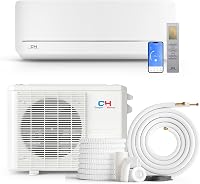
Cooper & Hunter 18000 BTU 230V
Best for remotely managed spaces - 6Check it
Pioneer Diamante Pro 12000 BTU 115V
Best for suitable 115V circuits - 7
 Check it
Pioneer Diamante Essenza 11500 BTU 115V
Best for simple room upgrades - 8Check it
Pioneer Diamante Pro 9000 BTU 115V
Best for smaller enclosed rooms
The best mini splits for the money by room and setup
Choose the Pioneer Diamante Pro 18000 BTU 230V for a properly sized larger zone, Senville for voice control, or a smaller Pioneer when the room needs less output. The scores rank the overall packages; capacity and installation fit should decide your purchase.
Pioneer Diamante Pro 18000 BTU 230V: for larger open zones
Pioneer Diamante Pro 18000 BTU 230V: Best for larger single zones
- 18,000 BTU cooling and heating
- 21.0 SEER2
- Recommended for 500 to 750 sq ft
- Heating operation down to -4°F
Choose this larger Diamante Pro for one open zone whose load calls for its capacity. Motorized airflow in both directions and remote temperature sensing help you direct comfort toward the occupied area.
Pros
- 21.0 SEER2
- Dual-axis motorized airflow
- Installation kit included
Cons
- Requires 230V power
- App control requires a separate module
The larger Diamante Pro suits an open living area, addition or workshop within Pioneer's recommended 500 to 750 sq ft range. Its 21.0 SEER2 efficiency makes it a strong starting point for a space you'll condition regularly.
Motorized up-down and left-right louvers give you more ways to direct air across an open room. I FEEL sensing uses the temperature near the remote, which is useful when your seating area feels different from the wall around the indoor unit.
The package includes the indoor and outdoor units, remote, insulated line set, signal cable, drain hose and wall sleeve. Ask the installer to check the route before assuming those components cover the whole job.
Skip it for a smaller enclosed room or a layout divided by closed doors. More capacity cannot make one indoor head deliver balanced comfort through separate rooms.
Choose this model when its load fit and installation quote both work. Our 18,000 and 24,000 BTU mini split guide helps you compare nearby sizes before committing.
Senville LETO 12000 BTU: for voice-controlled routines
Senville LETO 12000 BTU: Best for voice control users
- 12,000 BTU
- Alexa and app control
- Heat pump operation down to 5°F
- 16 ft line set
The LETO suits buyers who want temperature routines and Alexa control. Professional installation is required, and its parts and compressor warranty excludes labor.
Pros
- App and voice control
- Cooling, heating, dehumidifier and fan functions
- Five-year parts and compressor warranty
Cons
- Heating operation specified down to 5°F
- Professional installation required; warranty excludes labor
The Senville LETO suits a room where you'll use Alexa, app control and temperature routines. Those controls are useful for changing settings before you enter a home office or adjusting comfort without reaching for the remote.
It provides cooling, heating, dehumidifier and fan functions, plus turbo mode. The package includes a 16 ft line set and communication wire, and Senville requires professional installation.
Senville backs the parts and compressor with a five-year warranty, excluding labor. Keep installation records and check the warranty requirements before work begins, since a parts warranty does not cover every service expense.
Its heat pump operates down to 5°F. Skip it as an automatic choice for primary winter heating where colder temperatures are common; the installer needs to check output against local heat loss.
Pick the LETO when connected control will improve daily use. If winter heating drives the purchase, start with our guide to mini splits in cold weather.
Pioneer Diamante Pro 12000 BTU 230V: for mid-size additions
Pioneer Diamante Pro 12000 BTU 230V: Best for mid-size additions
- 12,000 BTU cooling and heating
- 20.0 SEER2
- Recommended for 350 to 500 sq ft
- Heating operation down to -4°F
This Diamante Pro fits a mid-size addition with suitable electrical service and a matching load. Remote sensing and adjustable airflow offer useful control without requiring an app.
Pros
- 20.0 SEER2
- Remote temperature sensing
- Washable, reusable filter
Cons
- Requires 230V power
- App control requires a separate module
This Diamante Pro suits an addition or renovated room within Pioneer's 350 to 500 sq ft recommendation. Its 20.0 SEER2 efficiency is useful for a room that needs cooling through much of the season.
Choose it over the larger Pioneer when the room's load calls for this capacity. Buying extra output as insurance can leave you with a system that spends too little time running steadily at the room's actual demand.
Remote sensing and motorized airflow let you adjust comfort around a desk or seating area. Cooling, Heating, Dry and Fan modes cover different conditions without requiring phone control.
Skip this version if the electrical work makes another suitable option a better overall deal. It needs 230V service, and adding app control requires a separate Pioneer AirLink module.
Compare the complete installation quote with the 12,000 BTU 115V Diamante Pro. Neither voltage is a reason to accept the wrong capacity or an unsuitable circuit.
DELLA Vario 12000 BTU Pre-Charged: for connected living areas
DELLA Vario 12000 BTU Pre-Charged: Best for connected living rooms
- 12,000 BTU
- Remote temperature sensing in cooling mode
- Up to 550 sq ft
- 16.4 ft installation kit
The Vario suits a living area where app control and cooling-mode remote sensing will see regular use. Its installation requires professional work and line-set vacuuming.
Pros
- Remote sensing in cooling mode
- Auto defrost and self-diagnosis
- App and Alexa support
Cons
- Requires line-set vacuuming
- Confirm exact-model efficiency before comparing energy savings
The DELLA Vario suits a living area where cooling-mode remote sensing and connected controls will be used often. Its sensor reads temperature at the remote rather than at the indoor head during cooling.
DELLA gives coverage guidance of up to 550 sq ft. App and Alexa support, sleep mode, a timer, auto defrost and self-diagnosis make it an option for buyers who want several control choices.
Plan for professional installation, including line-set vacuuming. The included kit is 16.4 ft, and changing the refrigerant line length requires the installer to address the refrigerant charge.
Its efficiency details conflict: DELLA identifies the Vario as 23 SEER2 in its title and feature description, while another specification gives 19 SEER2. Confirm the exact model's efficiency documentation before using it in an energy-savings comparison.
Choose it for its controls and room fit. Skip it if you want a DIY installation, and check that your home network supports its 2.4 GHz Wi-Fi connection.
Cooper & Hunter 18000 BTU 230V: for remote management
Cooper & Hunter 18000 BTU 230V: Best for remotely managed spaces
- 18,000 BTU cooling and heating
- 19.2 SEER2
- Smart Kit included
- Heating operation at 5°F
Choose this larger system when included phone control matters for an addition or separate workspace. Plan for professional installation and freight delivery.
Pros
- Smart Kit included
- 16 ft installation kit
- U.S.-based technical support
Cons
- Requires 230V power
- Freight delivery stops at the nearest accessible point outside
The Cooper & Hunter is a useful alternative for a larger zone when included app control matters. Its Smart Kit lets you manage settings by phone without budgeting for a separate control module.
It pairs 19.2 SEER2 efficiency with an installation kit containing a 16 ft insulated copper line set, communication cable and drainage extension. Professional installation is required.
Choose it for a separate workspace or addition where changing settings remotely saves a trip. Compared with the larger Pioneer, the main tradeoff is included connected control versus the Pioneer's higher seasonal cooling efficiency.
Skip it if you need confirmed heating performance below its stated 5°F operating point. Have the installer compare winter capacity with your room's heat loss before selecting it as the only heat source.
Also plan its arrival: freight delivery goes to the nearest accessible point outside your home. Arrange help moving the equipment, and complete Cooper & Hunter's required registration within 60 days of installation.
Pioneer Diamante Pro 12000 BTU 115V: for a suitable electrical plan
Pioneer Diamante Pro 12000 BTU 115V: Best for suitable 115V circuits
- 12,000 BTU cooling and heating
- 20.0 SEER2
- Recommended for 350 to 500 sq ft
- 115V system
This version suits a mid-size room when an electrician confirms that a 115V installation fits the project. Its efficiency matches the same-capacity 230V Diamante Pro.
Pros
- 115V system
- 20.0 SEER2
- Heating operation down to -4°F
Cons
- App control requires a separate module
- 115V does not guarantee an existing circuit is suitable
Choose this version when the room needs the mid-size Diamante Pro and an electrician confirms that 115V service suits the project. It shares the 230V version's efficiency and recommended room range.
The decision should come from the electrical plan rather than an assumption that lower voltage means easier setup. Circuit capacity, wiring, protection and the manufacturer's connection requirements still need checking.
Its remote sensing, adjustable louvers and operating modes make it suitable for a regularly occupied room. Pioneer also includes a washable filter and self-clean cycle for routine upkeep between deeper cleaning and service.
Optional phone control needs a separate AirLink module. If an app is central to how you'll use the system, include that accessory when comparing complete packages.
Skip it if your installer recommends a different electrical arrangement or the room needs another capacity. It is a voltage alternative within the same size class, rather than a reason to change your sizing plan.
Pioneer Diamante Essenza 11500 BTU 115V: for straightforward controls
Pioneer Diamante Essenza 11500 BTU 115V: Best for simple room upgrades
- 11,500 BTU
- 17 SEER2
- 115V system
- 16 ft line set
The Essenza is an entry-level choice for buyers who want remote control and a compact indoor unit. Compare its installed total with the more efficient Diamante Pro before deciding.
Pros
- Front-access washable filters
- 16 ft line set included
- Inverter compressor
Cons
- Lower efficiency than the 12,000 BTU Diamante Pro models
- Confirm cold-weather heating suitability before choosing
The Essenza suits buyers who want an entry-level system with remote control and a compact high-wall indoor unit. It includes a 16 ft line set and front-access washable filters.
Its indoor unit measures 30.5 inches wide and 9.75 inches high. Those dimensions help when planning a wall location, though the installer must still allow the required clearances and access for cleaning.
The inverter compressor varies speed to maintain the set temperature. Its 17 SEER2 efficiency is lower than the similarly sized Diamante Pro models, so compare installed totals alongside expected use.
Choose it if the installation quote is favorable and you value simple controls more than extra efficiency. A room used only occasionally gives you fewer operating hours over which to recover an efficiency upgrade.
Skip it for demanding winter heating without further capacity information. Confirm cold-weather suitability with Pioneer or the installer before relying on it for a room's main heat.
Pioneer Diamante Pro 9000 BTU 115V: for smaller enclosed rooms
Pioneer Diamante Pro 9000 BTU 115V: Best for smaller enclosed rooms
- 9,000 BTU cooling
- 10,000 BTU heating
- Recommended for 250 to 350 sq ft
- 115V system
The smallest system here is the better starting point for a smaller enclosed room. Its lower overall score does not make a larger unit a better fit for that space.
Pros
- Smaller capacity option
- Heating operation down to -4°F
- Installation kit included
Cons
- Unsuitable for loads beyond its capacity
- App control requires a separate module
The smallest Diamante Pro is the better starting point for a room within Pioneer's 250 to 350 sq ft recommendation. A smaller enclosed office or bedroom can need less capacity than the higher-ranked systems here.
It provides 9,000 BTU of cooling and 10,000 BTU of heating, with 19.0 SEER2 cooling efficiency. Its lower overall score should not push you toward a larger unit when this one matches the room's load.
Remote sensing and directional airflow help you manage comfort around the occupied area. Position the remote away from direct sunlight and heat-producing electronics when using its temperature sensor.
Skip it for a larger open area or a room with substantial heat loss unless a load calculation supports the choice. A small floor area can still have demanding conditions because of poor insulation or large windows.
For a garage, compare those conditions with our garage mini split guide before choosing by square footage alone.
How to choose a mini split that fits your budget
Choose by room load, complete installation cost and expected use, in that order. Efficiency and controls become useful comparisons after you have ruled out unsuitable capacities and electrical setups.
What room size fits the best mini split for the money?
The right size comes from the room's heating and cooling load, not floor area alone. Manufacturer coverage ranges help narrow the search, but they cannot capture your home's insulation, sun exposure or air leaks.
Give the installer ceiling height, window size and direction, insulation details and your usual temperature settings. Mention heat from equipment and whether the room connects to other spaces through open doorways.
Heating and cooling needs may point to different priorities. A sunny addition can have a high summer cooling load, while a shaded room in a cold climate may need more attention to winter output.
Use our mini split sizing guide before requesting quotes. For the broader system choices and installation basics, read our mini split heat pump guide.
Should you choose a 115V or 230V mini split?
Choose the voltage that fits an approved electrical plan for the correctly sized system. 115V does not mean plug-in installation, and it does not guarantee that an existing outlet or circuit is suitable.
Have an electrician or qualified installer check available circuit capacity, wiring, disconnect requirements and protective devices. Ask for electrical work to appear separately in the quote so you can see what changes between options.
Do not compare efficiency by voltage alone. A model's seasonal efficiency and your operating conditions matter more than treating one supply voltage as an automatic energy-saving feature.
Which efficiency figures matter for value?
Use SEER2 for seasonal cooling comparisons between suitable systems, then consider how often you'll run them. Higher efficiency has more opportunity to reduce electricity use in a room conditioned daily than in a rarely used guest room.
Heating efficiency needs its own comparison. HSPF and HSPF2 use different procedures, so do not treat those labels as interchangeable when comparing systems.
Ask for the exact indoor and outdoor model combination on the quote. If specifications conflict, resolve them before calculating savings rather than choosing whichever number looks better.
Your electricity rate, weather, settings and runtime determine the actual bill. Our guide to how much a mini split costs to run explains those factors.
Which controls are worth including?
Pay attention to controls you'll use every week. Phone access helps with changing schedules, while a handheld remote can cover a room that stays on a steady routine.
Remote sensing is useful when the occupied area differs in temperature from the wall around the indoor unit. Keep the remote in a representative location rather than beside a window, lamp or warm laptop.
Count required accessories in your comparison. An included smart controller can improve a package's value, but it should not outweigh correct sizing or create a reason to buy more capacity.
What should a complete installation quote include?
A useful quote covers the finished, working system, including electrical work, drainage and startup. An equipment package with an installation kit is only one part of that total.
Does an included installation kit make a system DIY?
An included kit does not make a system DIY. Senville, DELLA and Cooper & Hunter require professional installation, and all work must follow the specific system's instructions and local requirements.
A factory-charged outdoor unit does not remove the work needed to connect and prepare the refrigerant circuit. Read whether you can install a mini split yourself before deciding how to handle labor.
Ask prospective installers whether they will install equipment you buy separately. Confirm who handles startup, warranty paperwork and later service before ordering the system.
Plan the refrigerant route and drainage first
Have the installer measure the actual route between units, including bends and elevation changes. Straight-line distance through a wall may not reflect the line length the finished installation needs.
Condensate also needs a reliable exit route. Gravity drainage is often simpler where the layout allows it; our mini split condensate pump guide explains situations that may need a pump.
Confirm whether the quote includes wall sealing, line protection, mounting equipment and any permits. A cheaper quote that leaves those tasks open can be harder to compare with a complete one.
Place both units for airflow and service
Choose an indoor location with clear airflow into the occupied space and access to remove filters. Avoid placing furniture where it will block the air stream.
The outdoor unit needs the clearances and support required by its manual. In snowy areas, ask how the mounting position and drainage will handle snow buildup and defrost water.
Keep both units accessible for service. Hiding equipment in a tight corner can make cleaning and repairs harder even if the location looks tidy.
How should you use and care for a mini split?
Use steady, sensible settings and clear airflow, then follow the manual's cleaning schedule. Daily operation and basic care help the installed system deliver the comfort you bought it for.
Use settings that suit an inverter system
Set a comfortable target rather than repeatedly choosing the lowest cooling setting or highest heating setting. An extreme target does not change the room's insulation or remove the system's capacity limits.
Avoid large, frequent temperature swings when you want steady comfort. If you use schedules, choose changes that suit your occupancy and allow enough recovery time.
Keep windows closed while conditioning the room. Ceiling or room fans can help move air around the occupied area, but they cannot make one indoor head serve distant closed rooms evenly.
Keep filters and drainage clear
Inspect filters regularly, especially in dusty rooms or homes with pets. Clean them at the intervals and by the method in the manual, and let washable filters dry before reinstalling them.
A self-clean cycle does not replace filter care or professional service. Keep leaves and debris away from the outdoor unit without blocking its required airflow.
Watch for indoor drips, new odors, unusual noises or declining airflow. Arrange service when those changes persist rather than trying to compensate with a more extreme temperature setting.
Which buying mistakes waste the most money?
The biggest mistakes are wrong sizing, incomplete quotes and assuming an operating limit guarantees winter comfort. Avoiding those errors matters more than collecting features.
Do not buy the top-ranked model before checking the room load. A lower-ranked system in the correct size can be the stronger choice for your home.
Do not assume a parts warranty pays for labor, diagnostic visits or every installation-related issue. Keep receipts, model details, registration records and the installer's contact information together.
For winter heating, ask about capacity at your local design temperature and whether backup heat is needed. A minimum operating temperature tells you the system can run there, rather than how much heat it can deliver.
Which mini split is the better value for your room?
The best mini split for the money is the correctly sized option with a complete installation plan you can afford. Use these decision rules after getting the room load and electrical requirements checked.
- Choose the larger Pioneer Diamante Pro for a matching larger zone when seasonal cooling efficiency is a priority.
- Choose Senville LETO for Alexa routines, or Cooper & Hunter when a larger zone needs included phone control.
- Compare the mid-size Pioneer versions by electrical work, and choose DELLA Vario for its connected controls after resolving its efficiency details.
- Consider Essenza when its complete quote favors a simple setup, or the 9,000 BTU Pioneer when a smaller room calls for less capacity.
For a garage, use our best mini splits for garages guide to check insulation and door-related loads. If you're still deciding whether the complete project makes sense, read are mini splits worth it? before ordering equipment.
Our top 3 picks at a glance
-
1
-
2
-
3
Frequently asked questions
How do I choose the best mini split for the money?
Choose by room load and complete installed cost first, then compare efficiency and controls; have an installer assess insulation, windows, ceiling height and climate before selecting capacity. A smaller system that fits the room can offer better value than a higher-scoring model that needs extra electrical work or has excess capacity.
Is a 12,000 BTU mini split enough for a garage?
A 12,000 BTU system can suit some garages, but insulation, door leaks, ceiling height and outdoor temperatures determine the load. Pioneer's Diamante Pro models in this size have a 350 to 500 sq ft recommendation; use our mini split garage guide to identify the conditions your installer should assess.
Do mini splits include everything needed for installation?
No, an installation kit covers core components rather than every requirement at your home; electrical work, mounting hardware, a longer refrigerant route or a condensate pump may add to the project. Ask your installer for an itemized quote that covers the complete setup, startup work and any required permits.
Can a mini split heat a room in very cold weather?
Yes, a suitable mini split can heat in cold weather, but its lowest operating temperature is not a promise of full heating output. Match its low-temperature capacity to your room's heat loss; read our cold-weather mini split guide and have an installer determine whether backup heat is needed.