7 Best Mini Splits for Cold Climates (November 2026)
The best mini splits for cold climates include the Pioneer Diamante Pro 18000 BTU 230V for larger living areas, the Pioneer Diamante Pro 12000 BTU 230V for medium room upgrades, and the Pioneer Diamante Pro 12000 BTU 115V for planned 115V installations.
On this page (8 sections)
- Which is the best mini split for cold climate heating?
- How did we compare these cold-climate systems?
- How should you choose a mini split for a cold climate?
- What does a mini split's minimum temperature tell you?
- How much capacity does your cold-climate room need?
- What should a cold-weather installation include?
- How should you run and care for a mini split through winter?
- Which cold-climate mini split should you buy?
The best mini split for cold climate use in a larger zone is the Pioneer Diamante Pro 18000 BTU 230V, provided its -4°F heating limit fits your winters. For severe cold, consider the Cooper & Hunter Hyper Heat or MRCOOL DIY Hyper Heat after matching winter output to the room.
The right choice starts with heat loss and local winter temperatures. A low operating limit helps narrow your options, but heating capacity at that temperature determines whether the room stays warm.
For broader context, read our guide to mini split heat pumps and installation basics and our explanation of how mini splits work in cold weather.
Our picks at a glance
-
1

-
2

-
3
Best for planned 115V installations
Pioneer Diamante Pro 12000 BTU 115V
8.0/10 our score
See it on Amazon
- 4
 Check it
Cooper & Hunter 24000 BTU 230V Heat Pump
Best for open room layouts - 5Check it
Pioneer Diamante Pro 9000 BTU 115V
Best for compact home offices - 6
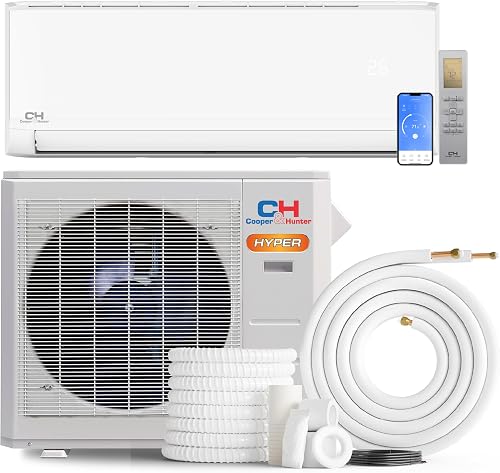 Check it
Cooper & Hunter 24000 BTU Hyper Heat
Best for severe winter regions - 7
 Best for capable DIY renovatorsCheck it
Which is the best mini split for cold climate heating?
The Pioneer 18000 BTU is our first choice for a larger zone in moderate cold. Choose a Hyper Heat option instead when your climate calls for a lower operating limit, then confirm its output against the room's winter demand.
These picks serve different room sizes and installation plans. The highest score doesn't make one system right for every climate, and a smaller room shouldn't get a large unit simply because it can run in colder weather.
1. Pioneer Diamante Pro: best cold-climate mini split for larger zones
Pioneer Diamante Pro 18000 BTU 230V: Best for larger living areas
- 18,000 BTU heating and cooling
- Heating down to -4°F
- 21.0 SEER2
- 9.5 HSPF2
Choose this Pioneer for a larger defined zone in moderate winter conditions. Its motorized louvers and remote temperature sensing help you direct heat toward the occupied part of the room.
Pros
- Largest recommended area among the Pioneer picks
- Motorized airflow in both directions
- Washable filter and self-clean cycle
Cons
- Warmer heating limit than the Hyper Heat options
- App control requires a separate module
Choose this Pioneer for an open living area, addition or workshop that needs its capacity. Its 500 to 750 sq ft recommendation is a useful starting point, with final sizing based on insulation, windows and winter heat loss.
The airflow controls are useful in a long room where heat needs to reach beyond the wall unit. Motorized louvers move in both directions, while I FEEL uses the temperature near the remote to guide comfort.
Keep that remote near the occupied part of the room, away from direct sunlight or another heat source. A remote left beside a drafty door can give the system a poor picture of where you sit.
Skip this model if winter temperatures regularly fall below its operating range or the room needs more heat than it delivers in cold air. The included installation kit helps with setup, but circuit work, mounting and refrigerant connections still need a complete installation plan.
2. Pioneer Diamante Pro 12000 BTU 230V
Pioneer Diamante Pro 12000 BTU 230V: Best for medium room upgrades
- 12,000 BTU heating and cooling
- 230V system
- 20.0 SEER2
- 9.5 HSPF2
This model suits a medium room where the electrical plan calls for 230V service. Choose it for the room's calculated load, rather than stepping up to a larger system for extra margin.
Pros
- Inverter compressor adjusts output
- I FEEL remote temperature sensing
- Installation kit included
Cons
- Not intended for temperatures below its heating limit
- Wi-Fi module sold separately
Choose this version for a medium room with a planned 230V circuit, especially when the larger Pioneer would exceed the calculated load. Its recommended area is 350 to 500 sq ft, making it a candidate for a defined living room or addition.
The inverter compressor adjusts output as demand changes. That suits a room needing steady heat through the day, rather than occasional blasts of warmth after the space has become very cold.
Sleep, Timer and Mute functions give you ways to adjust daily use. Start with a steady temperature and adequate airflow before reducing fan speed for quiet, since heat still needs to reach the room.
Skip it if you want included smartphone control, because Pioneer AirLink requires a separate module. Also skip it when the heat-loss calculation points to a smaller system or your winter conditions call for a colder operating range.
3. Pioneer Diamante Pro 12000 BTU 115V
Pioneer Diamante Pro 12000 BTU 115V: Best for planned 115V installations
- 12,000 BTU heating and cooling
- 115V system
- 20.0 SEER2
- 9.5 HSPF2
Choose this version when a suitable 115V circuit fits the installation plan for a medium room. It shares the main capacity and efficiency figures of the 230V version.
Pros
- 115V option for a medium zone
- Motorized louvers
- Washable dust filter
Cons
- Existing circuit suitability needs confirmation
- App control requires a separate module
Choose the 115V version when the electrical design favors that voltage and the room needs this capacity. It has the same main capacity and seasonal efficiency figures as the 230V version, so voltage should follow the installation plan.
This can suit a medium home office or renovated room where extending ductwork would be awkward. Its washable dust filter also makes routine filter care straightforward without a regular disposable-filter purchase.
Don't confuse the voltage with a promise of simple plug-in setup. Have an electrician confirm the required circuit, wiring and protection before treating existing power as usable.
Skip this model if you're choosing it only to avoid electrical planning or expecting 115V to improve winter efficiency. The decision between these 2 Pioneer versions is about suitable service and installation requirements, with the room load deciding capacity.
4. Cooper & Hunter 24000 BTU 230V Heat Pump
Cooper & Hunter 24000 BTU 230V Heat Pump: Best for open room layouts
- 24,000 BTU
- 230V system
- Smart Kit included
- Professional installation required
Consider this system for a large open zone with professional installation and included smartphone control. Cooper & Hunter states heating down to -13°F; confirm winter capacity for the exact matched system.
Pros
- Large-zone capacity
- Smart Kit included
- Pre-charged outdoor condenser
Cons
- Professional installation required
- Efficiency figures need confirmation for the exact model
Consider this Cooper & Hunter for a large open room with professional installation. The included Smart Kit suits buyers who want smartphone control without adding a separate control module.
Cooper & Hunter states heating down to -13°F for this system. Ask your installer for the matched indoor and outdoor units' heating output at your local design temperature before using it as the main winter heat source.
Its efficiency figures need clarification for the exact model, so don't choose it based on a headline cooling number. Ask for the matched-system efficiency documentation and compare heating performance first.
The package includes a 16 ft installation kit, but your route may need different materials or additional work. Skip this system for a compact room or a DIY project, and plan freight delivery to an accessible outdoor point before the installation crew arrives.
5. Pioneer Diamante Pro 9000 BTU 115V
Pioneer Diamante Pro 9000 BTU 115V: Best for compact home offices
- 9,000 BTU cooling
- 10,000 BTU heating
- 19.0 SEER2
- 9.5 HSPF2
This is the smallest Pioneer option here for a compact office or other defined room. Its heating and cooling capacities differ, so size it for both winter and summer demand.
Pros
- Smallest recommended room range here
- 115V system
- Remote temperature sensing
Cons
- Unsuitable when the room's winter load exceeds its output
- App control requires a separate module
Choose this Pioneer for a compact office or other small defined zone where a larger system would be unnecessary. Pioneer recommends 250 to 350 sq ft, subject to the room's actual heating and cooling loads.
Its 10,000 BTU heating capacity differs from its 9,000 BTU cooling capacity. That distinction matters when comparing systems by the large number in the product name, which may describe cooling rather than winter output.
A small zone still needs careful placement. Avoid directing the indoor unit straight toward a nearby wall or tall cabinet, and leave access for filter removal and cleaning.
Skip it for a drafty space with high heat loss or a room expected to heat adjoining closed rooms. The smallest option can be the right choice for a well-matched zone, but it shouldn't be asked to cover an entire floor through a narrow doorway.
6. Cooper & Hunter 24000 BTU Hyper Heat
Cooper & Hunter 24000 BTU Hyper Heat: Best for severe winter regions
- Heating down to -22°F
- 24,000 BTU
- 22.3 SEER2
- Smart Kit included
This is the professional-install option to consider for a larger zone in severe cold. Match its low-temperature heating output to the room before relying on it as the main heat source.
Pros
- Colder heating limit than the Pioneer picks
- Smartphone control included
- Inverter compressor
Cons
- Professional installation required
- May be too large for a small room
Choose this Hyper Heat system for a larger zone facing severe winter weather, with installation handled by a licensed technician. Cooper & Hunter specifies heating operation down to -22°F, the lowest stated heating limit among its 2 options here.
The Smart Kit and 16 ft installation kit are included. This makes it worth comparing with the standard Cooper & Hunter when winter operation matters more than choosing a general all-season system.
Before committing, ask for low-temperature capacity and the system's minimum heating output. Both matter: it must cover the coldest design conditions without being poorly matched to the room during milder weather.
Skip it if your room needs much less capacity or you're looking for self-installation. Freight handling, outdoor mounting and snow clearance should all be included in the contractor's plan, rather than left until delivery day.
7. MRCOOL DIY Hyper Heat
MRCOOL DIY Hyper Heat: Best for capable DIY renovators
- 12,000 BTU
- DIY quick-connect design
- 23.5 SEER2 and 10 HSPF2
- Wi-Fi and voice assistant support
MRCOOL combines a low stated operating limit with quick-connect installation and built-in smart controls. Confirm the exact system's coverage and winter output before planning a DIY project.
Pros
- Quick-connect DIY design
- Stated operation down to -22°F
- Alexa and Google Assistant support
Cons
- Room coverage guidance varies
- Electrical work and local requirements still apply
Choose MRCOOL when quick-connect installation is a main priority and you're comfortable following a detailed installation manual. This 12,000 BTU version combines 23.5 SEER2 cooling efficiency with 10 HSPF2 heating efficiency.
Built-in Wi-Fi and Alexa and Google Assistant support suit buyers who want remote temperature changes and scheduling. Those controls are convenient for an office or addition used on a regular schedule.
MRCOOL's room coverage guidance varies, so use a heat-loss calculation rather than choosing the most generous area estimate. Confirm the exact matched system's winter heating output as part of that decision.
Skip it if you need someone else to handle mounting, wall penetrations, drainage and startup checks. A DIY refrigerant connection reduces one part of the job; local rules, electrical work and safe handling of the outdoor unit still need attention.
How did we compare these cold-climate systems?
We compared winter operating limits, capacity, room fit, efficiency and installation needs. The product order follows the scores, while the recommendations separate moderate-winter choices from systems intended for colder conditions.
The Pioneer models share many controls and care features. Their main buying differences are capacity and voltage, so repeating the same feature list doesn't help you decide between them.
For the Cooper & Hunter options, the choice centers on winter range, room load and professional installation. MRCOOL adds a distinct installation path, which matters only if the system also fits your room and climate.
A model's low operating limit earns attention, but the final choice needs performance information for the exact indoor and outdoor combination. Ask for that match before approving an installation quote.
How should you choose a mini split for a cold climate?
Start with your winter design temperature and a room heat-loss calculation, then compare heating output at that temperature. This gives you a clear shortlist before you weigh controls, installation style or cooling efficiency.
Match the system to your winter design temperature
Use the local winter design temperature as the sizing reference. It represents a cold condition used for planning heat demand, while unusually severe weather still deserves a backup plan.
Give the installer your intended indoor temperature and describe how the room is used. A workshop kept cool between visits has a different comfort goal from a living room occupied throughout the day.
Ask where the mini split's available heating output meets the room's heat demand. Below that point, supplemental heat may be needed even while the compressor can still operate.
Compare heating capacity at the same outdoor temperature
Compare all candidates at a common cold-weather temperature. A nominal capacity measured under milder conditions isn't a fair comparison with another unit's output in severe cold.
Request heating capacity, power input and coefficient of performance, or COP, at the temperatures relevant to your area. COP describes heat delivered relative to electricity used at a particular condition.
If a contractor recommends a system as your only heat source, the quote should explain how its winter capacity covers the calculated load. A general assurance that it is a cold-climate model leaves that question unanswered.
Read HSPF2 and SEER2 for different jobs
Use HSPF2 to compare seasonal heating efficiency and SEER2 to compare seasonal cooling efficiency. Compare figures under the same rating system, since SEER and SEER2 aren't interchangeable.
Seasonal efficiency helps judge energy use across a season. It doesn't replace the low-temperature capacity check needed to keep a room warm on the coldest design day.
For a heating-led purchase, prioritize winter capacity and suitable sizing first. Use efficiency to compare the systems that pass those checks.
What does a mini split's minimum temperature tell you?
The minimum temperature tells you the lowest outdoor temperature specified for operation, while a capacity table tells you how much heat is available there. You need both to judge a cold-weather system.
A system may continue running while delivering less heat than the room loses. In that case, the indoor temperature can fall even though the equipment is operating within its stated range.
For a deeper explanation, see how cold a mini split heat pump can work. Use that distinction when discussing primary heat, supplemental heat and backup with your installer.
Cold-weather operation also includes defrost cycles. A heat pump may briefly redirect heat to clear frost from the outdoor coil, causing a pause in indoor heating.
Some frost and periodic defrosting are normal. Heavy ice that remains, falling indoor temperatures or repeated faults call for service rather than a higher thermostat setting.
How much capacity does your cold-climate room need?
Choose capacity from heat loss, room layout and the unit's output in cold air. Floor area helps narrow the search, but it doesn't account for drafty windows, insulation or an exposed floor.
Size the room before choosing the equipment
An addition over an unheated space can need more heat than a same-size room surrounded by conditioned rooms. High ceilings, large windows and frequent door opening can also change the load.
Use our mini split sizing guide to prepare room details, then get a professional load calculation. Include planned air sealing or insulation work so the system is sized for the finished space.
Avoid buying extra capacity for reassurance
An oversized system may cycle more often when demand falls below its minimum output. That can reduce comfort during mild weather, even if its peak capacity looks reassuring for winter.
Ask about the minimum output as well as maximum output. An inverter can adjust capacity, but it still has a lower operating range.
Treat separate rooms as separate comfort needs
A wall-mounted head serves the air it can move through its zone. Closed doors, corners and narrow halls limit how much heat reaches other rooms.
Don't buy a larger single-zone unit simply to push heat through several bedrooms. Discuss separate zones or another heat source when the floor plan blocks airflow.
What should a cold-weather installation include?
A good installation includes load sizing, electrical work, drainage and a snow-ready outdoor location. Ask for these items in the scope before equipment arrives.
Place the outdoor unit above snow and ice
Mount the condenser above expected snow accumulation using a suitable support. Keep the manufacturer's required clearances around the coil, fan and service panels.
Avoid roof areas that shed snow, icicles or runoff onto the unit. Also consider where plowed snow collects, since a clear location in autumn may become blocked in January.
Leave defrost water a path away from the equipment and walking surfaces. Ice forming beneath the unit can become a problem if repeated thawing and freezing has nowhere to drain.
Plan indoor airflow and cooling drainage
Place the indoor head where air can reach the occupied zone without a nearby obstruction. Leave room for service and avoid aiming the air stream directly at a desk or bed.
The indoor cooling drain needs a suitable route and slope. If gravity drainage isn't possible, our guide to mini split condensate pumps explains when a pump may be needed.
Separate included parts from completed installation
An installation kit doesn't cover every site's needs. Line length, wall construction, electrical work, supports and drainage can change the job.
A pre-charged outdoor condenser also doesn't make every system suitable for DIY work. The Cooper & Hunter units require professional installation, while MRCOOL uses a quick-connect design intended for self-installation.
For a clearer division of tasks, read whether you can install a mini split yourself. Confirm local permit and electrical requirements before opening walls or mounting equipment.
How should you run and care for a mini split through winter?
Use a steady heating setting, clear airflow and regular filter care to help the system maintain comfort. Large temperature swings can make recovery slow when outdoor conditions are harsh.
Start with a steady setpoint
Begin with Heat mode and a moderate, steady indoor temperature. Adjust gradually after seeing how the occupied part of the room responds.
Deep overnight setbacks may leave the system recovering during the coldest morning hours. A smaller setback can be more practical when the mini split is the main source of heat.
Use enough fan speed to distribute warmth across the zone. Quiet modes are useful, but low airflow may leave distant seating areas cooler.
Keep filters and outdoor airflow clear
Inspect washable filters regularly and clean them according to the manual. A dusty workshop may need more frequent attention than a little-used bedroom.
Keep leaves and loose snow away from the outdoor unit without blocking access or clearances. Never chip ice from the coil or pour hot water over frozen equipment.
A self-clean cycle doesn't replace filter care or professional service. Arrange service if heat output changes sharply, water drains where it shouldn't or the system develops repeated faults.
Know when backup heat should take over
Agree on a backup plan before severe weather arrives. It should cover temperatures below the equipment's limits, capacity shortfalls and equipment failure.
If backup heat is automatic, have the installer explain its controls and changeover settings. Everyone using the space should know what to do if the room keeps cooling despite a call for heat.
Which cold-climate mini split should you buy?
Choose the best mini split for cold climate heating by winter output and room load first, then settle the installation method. A suitable operating range, manageable minimum output and clear installation scope make the decision stronger than a large nominal capacity.
Pick the Pioneer 18000 BTU for a larger defined zone in moderate winter conditions. Choose one of the smaller Pioneer models when the load is lower, with voltage following the electrical plan.
Consider the standard Cooper & Hunter for a large open zone after confirming its exact performance figures. Move to Cooper & Hunter Hyper Heat when severe winter conditions call for its lower heating limit and professional installation suits your plans.
Choose MRCOOL DIY Hyper Heat when quick-connect installation is a priority and the exact system meets the room's winter load. Before ordering any model, have the capacity, circuit, mounting location and backup plan settled.
For a broader comparison of heating-focused options, browse our mini splits for heating guide.
External reference: U.S. Department of Energy: Air-Source Heat Pumps
Our top 3 picks at a glance
-
1
-
2
-
3
Best for planned 115V installations
Pioneer Diamante Pro 12000 BTU 115V
8.0/10 our score
See it on Amazon
Frequently asked questions
What temperature can a cold-climate mini split handle?
The limit depends on the model. Pioneer specifies heating down to -4°F for these Diamante Pro units, while Cooper & Hunter specifies -22°F for its Hyper Heat system.
MRCOOL states operation down to -22°F.
Check heating capacity at your local winter design temperature before choosing a main heat source.
Is a mini split enough to heat a home in a cold climate?
A mini split can heat a cold-climate home if its winter output covers the building's heat loss and the layout allows heat to reach occupied rooms. These are single-zone systems, so closed rooms may need separate heat.
Have an HVAC professional size the system and plan any backup heating.
Does a lower operating temperature mean better heating?
A lower operating limit means the system can operate in colder outdoor air, but it doesn't show how much heat it delivers there. Compare low-temperature capacity with the room's heat loss.
Seasonal heating efficiency, minimum output, installation quality and backup heating needs also affect which system fits your home.
Should I choose 115V or 230V?
Choose the voltage required by the system and supported by a properly designed circuit. Neither voltage alone proves better cold-weather heating.
Ask an electrician to confirm breaker size, wire size, disconnect requirements and panel capacity.
A 115V mini split should never be assumed suitable for a spare household outlet.
Why does a mini split pause heating in winter?
A heat pump may briefly pause indoor heating while it defrosts the outdoor coil. Frost can form as the system draws heat from cold outdoor air.
Persistent heavy ice, long losses of room temperature or repeated faults need professional attention.
Keep snow and debris clear without chipping ice from the coil.


